Buying Land to Build a House? Run These 5 Numbers Before You Sign
A first-time builder told me last month, with a big grin: "I found the perfect lot."
I asked him one question. "What's the lot price as a percentage of what you'll sell the finished house for?"
He had no idea what I was talking about.
Buying land to build a house is the biggest financial bet most first-time builders ever make. And he was about to make it blind - about to wire six figures on a piece of dirt, take out a construction loan bigger than most people's mortgages, with not a single number run. He wasn't building a spec house. He was placing a bet and calling it a plan.
A lot is not a good deal because you like it. A lot is a good deal because the math says so. And most first-time builders never do the math.

So here's a real spec build deal - a real lot, real numbers, and a real guy who almost lost everything - broken into the five numbers I run before I sign on any property.
The Same Lot, Two Completely Different Outcomes
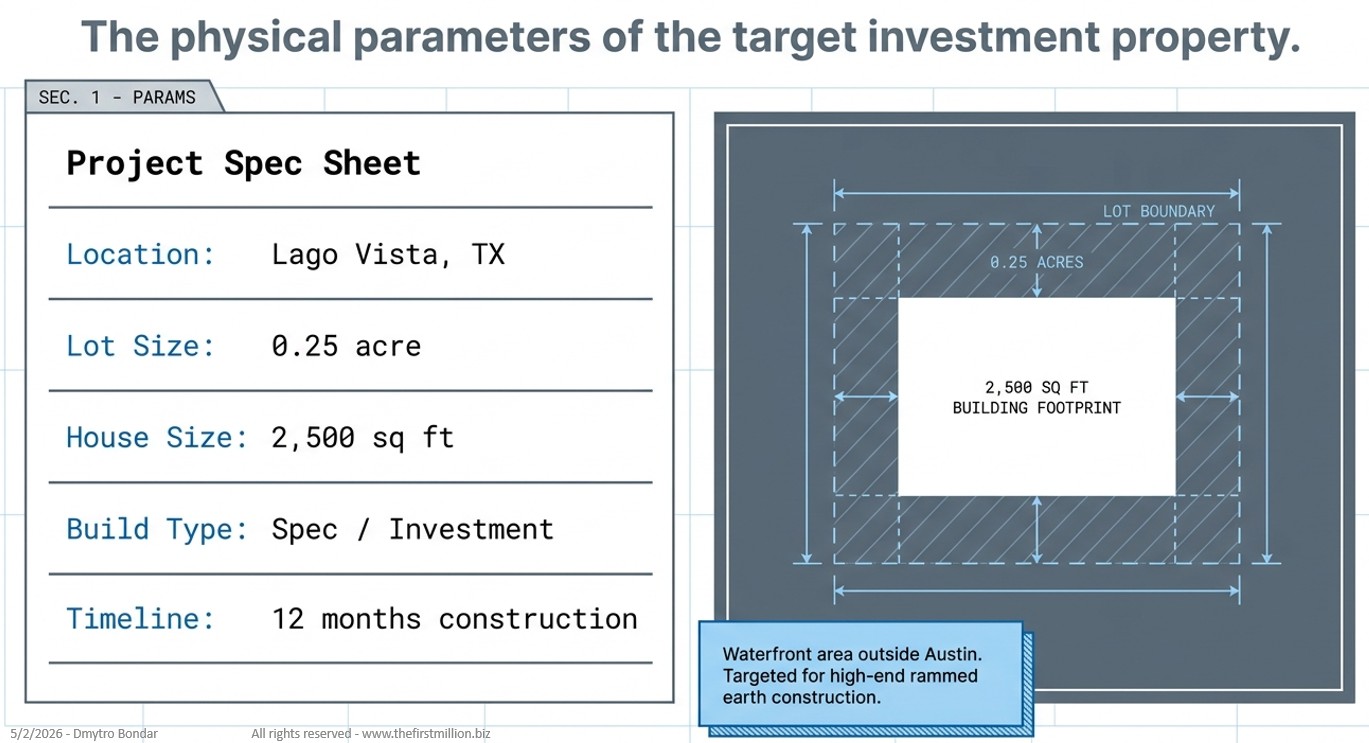
Ten years ago, a builder I knew here in Austin bought a lot for $21,000. Today that exact same lot in Lago Vista runs $150,000 to $200,000. Same dirt. Same house plan. Same builder.
At $21,000, his build penciled out to about $157,000 in profit.
Run that identical project today, at today's lot price, and it loses $41,500.
I broke this exact deal down on video too. Watch it if that's more your speed - otherwise let's run the numbers.
Nothing about the house changed. Same square footage, same finishes, same crew. The only things that moved were the price of the dirt and what buyers will pay. And that flipped a $157,000 win into a $41,500 loss.
When someone tells me a lot "feels like a deal," I don't argue. I ask them to run five numbers. Here they are.
Number One: The Lot Ratio That Kills Bad Deals in 30 Seconds
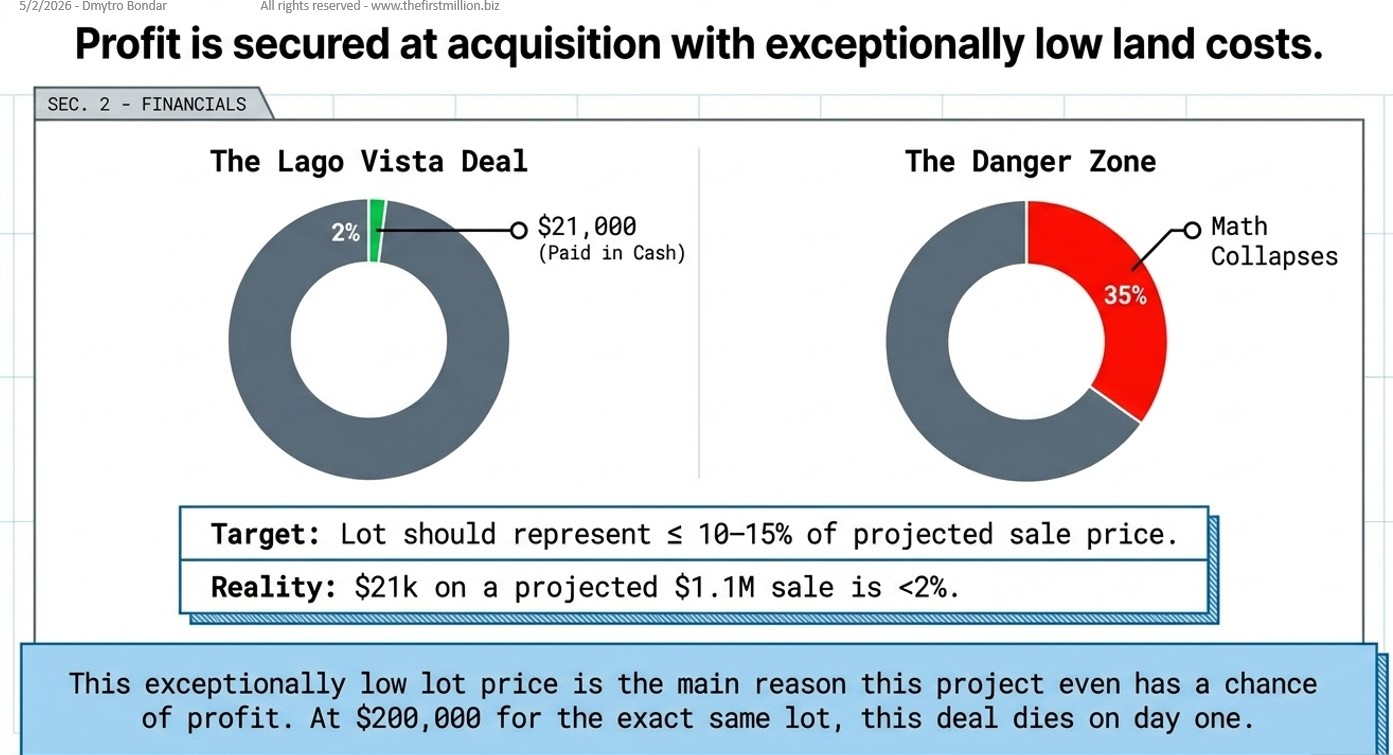
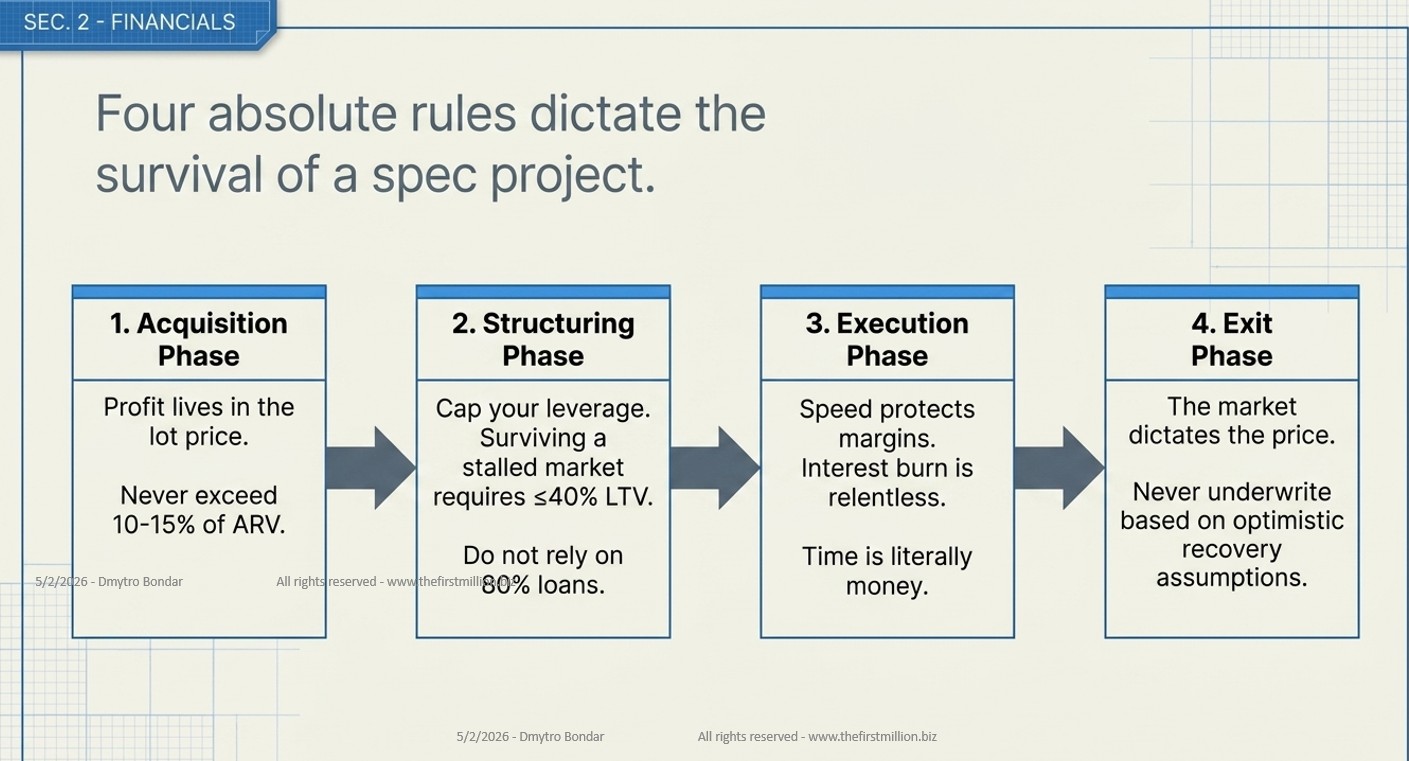
In a normal market, your lot should cost 10 to 15% of what you'll sell the finished house for. Twenty percent is the ceiling. Go past that and the deal is squeezed before you pour a single footing.
My Austin guy's $21,000 lot against a $1.1 million projected sale price came out to under 2%.
That wasn't smart underwriting. He got lucky. But that 2% is the only reason the deal had any room to breathe.
Buy that same lot today at $150K to $200K and you're at 14 to 18%, right at the edge. Push it to $300,000 and you're at 27%. In a standard market, that deal is dead. You cannot make money on it, no matter how much you love the trees.
This check takes thirty seconds. Most builders never run it. They find a lot, fall in love, and write the offer at whatever the seller is asking.
Number Two: The Soft Costs in Construction Nobody Warns You About
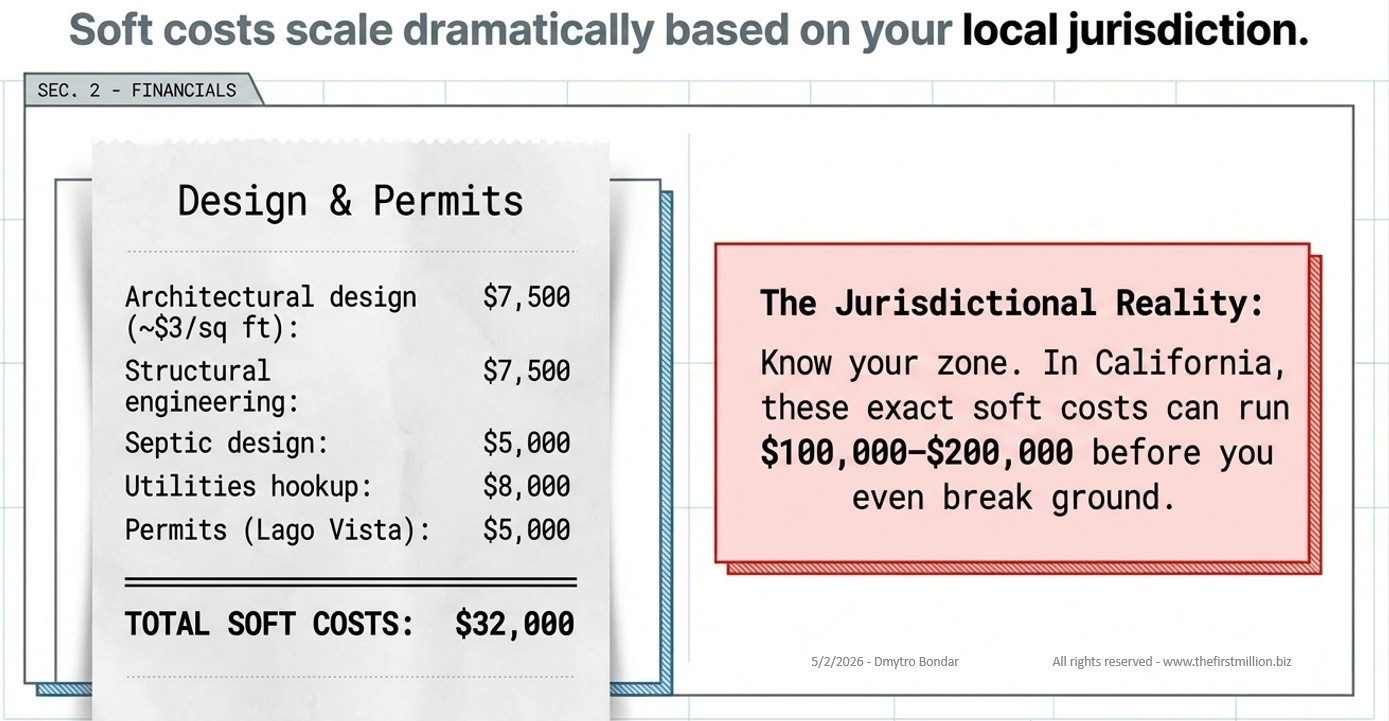
Most first-timers budget for the lot and the construction and figure that's the project. They forget the stack of fees you pay in cash, upfront, before a single trade shows up. These are the soft costs in construction that catch everyone off guard. For a 2,500 square foot house here in Central Texas:
Architectural design: about $7,500
Structural engineer: about $7,500
Septic design: about $5,000
Utility hookups: about $8,000
Permits: about $5,000
That's roughly $32,000 in cash before anyone breaks ground.
And these soft costs scale hard based on where you build. The same home in California can run $100,000 to $200,000. Permits alone out there can be twenty times what we pay in Texas. Where you build decides what you pay before construction even starts, and nobody on Zillow puts that in the listing.
Number Three: The Construction Loan Costs Money to Borrow (and Time Is Money)
Most builders treat the construction as one number. It's actually three: the build, the cost of borrowing, and the clock.
The build itself, for a standard-spec 2,500 square foot house at about $250 a square foot, runs around $625,000. That number is the heart of the cost to build a house in Texas at this size - and if you want the full breakdown of where construction costs landed this year and how to budget the cost to build a house per square foot, see my guide on what it actually costs to build a house in 2026.
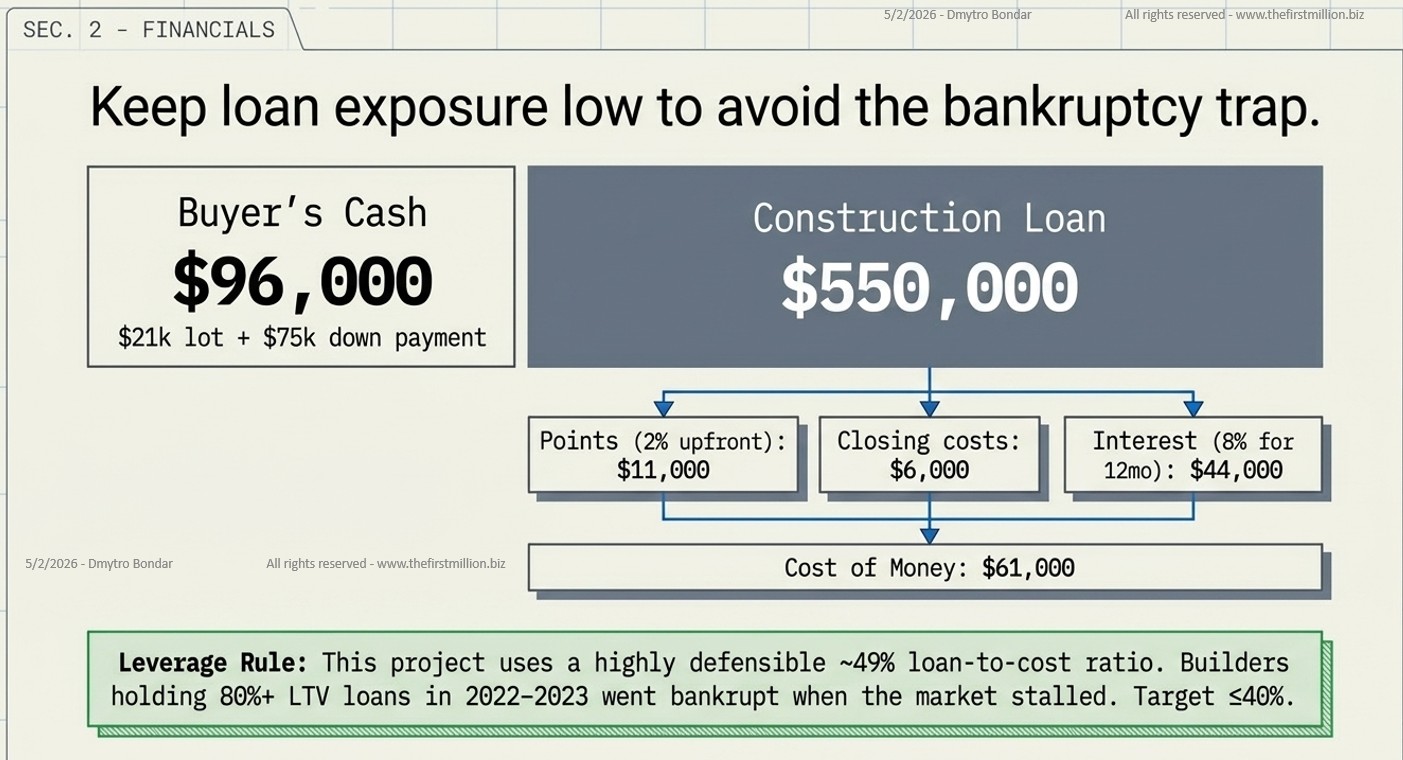
Now finance $550,000 of that build with a construction loan. The loan comes with:
2% in points: $11,000
Closing costs: $6,000
8% interest over 12 months: $44,000
That's $61,000 just to use the money for a year. It is not in your build budget. It's on top of it.
Then there's the clock. At 8% on $550,000, you're burning about $3,600 in interest every single month. Build time is a financial instrument. If your 12-month build slips to 18 months, another $21,600 evaporates straight off your bottom line. Speed protects margins. Delays destroy them.
This is also the number that bankrupted builders I knew. The rule: keep your leverage low. Target a loan-to-cost ratio of 40% or under. This deal ran about 49% loan-to-cost, which is still defensible. The Texas builders who blew up in 2022 were levered at 80% or higher. When the market stalled, they couldn't carry the loans, and they lost everything. Same houses, same builds, different leverage, opposite endings.
Number Four: The Cash That Almost Sank My Friend
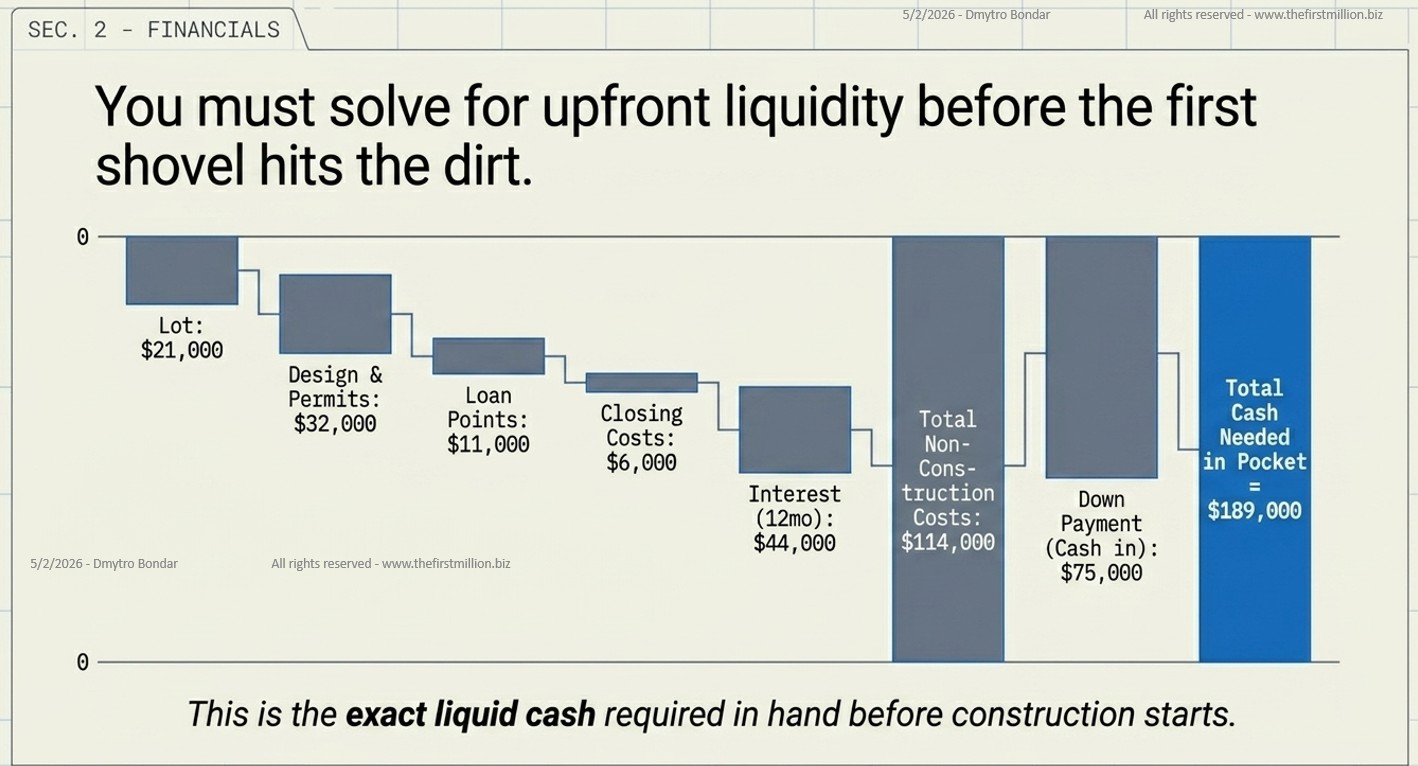
Most builders assume the construction loan covers everything. It doesn't. There's a separate pile of cash you need sitting liquid in your account before the first shovel hits the dirt.
Add it up for a typical first build: $21,000 lot, $32,000 soft costs, $11,000 points, $6,000 closing, $44,000 interest, and a $75,000 down payment. That down payment is one of the construction loan requirements most first-timers never see coming. All in, that's $189,000 in cash you need on hand to start a 2,500 square foot house in Central Texas.
Most first-time builders do not have this number. They thought the loan covered it. It doesn't.
My Austin guy hit month three, the contractor needed a draw, and the cash he'd burned on soft costs was gone. He was one bad week from either freezing the project or borrowing at 15% and watching his margin vanish.
He got bailed out. A relative wrote him an $80,000 check and the build survived. But how many first-time builders have a relative with $80,000 sitting around? Almost none. That's why I tell everyone to carry a 15% reserve on top of everything, which on this deal would have been about $217,000 liquid. Not "approved." Not "promised." Actually in the account.
Number Five: The Test That Separates Builders From Gamblers
You control your costs. You do not control what a buyer will pay when you sell. The one thing you do control is the test you run before you sign.
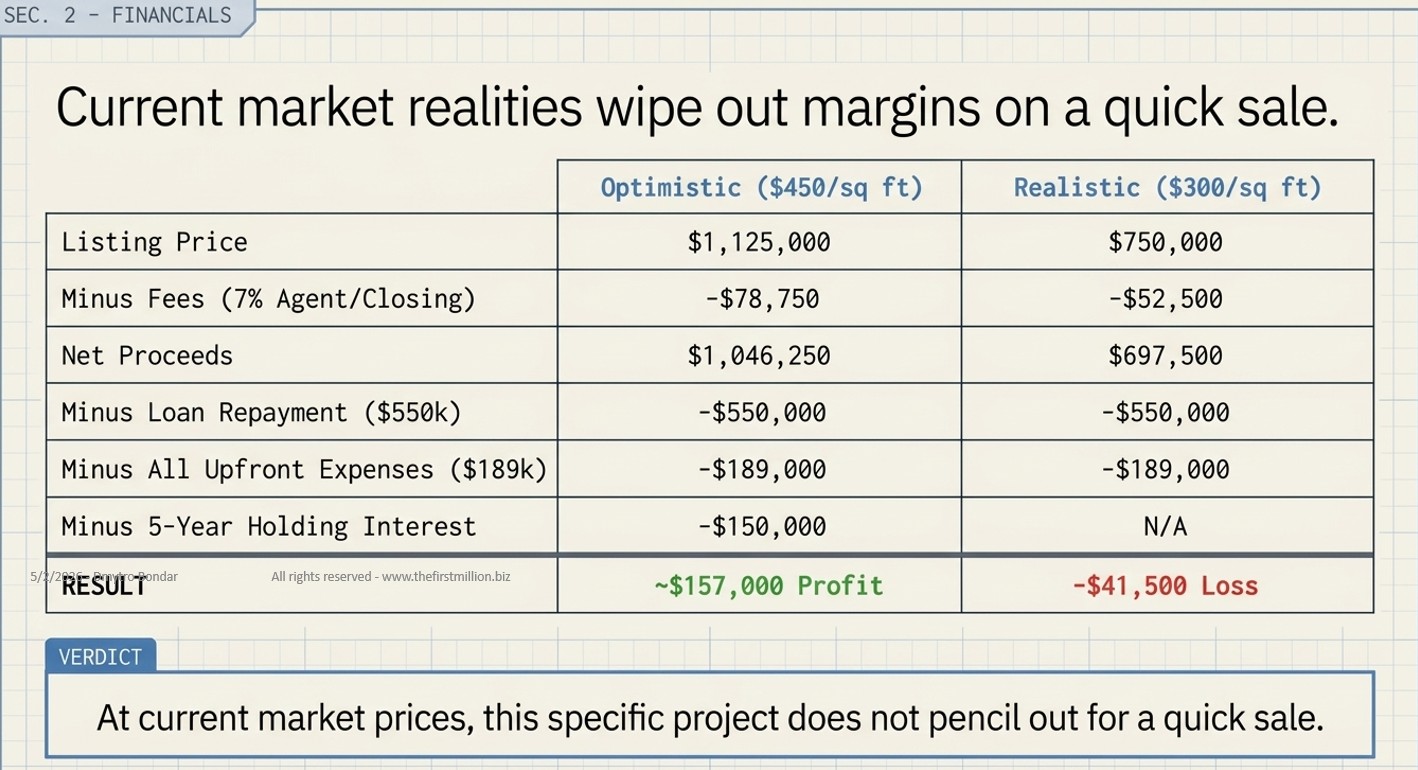
Run the deal two ways.
The optimistic case: the market recovers to $450 a square foot and you list at $1.125M. But here's the part most builders skip - that price requires holding the property for five years to let the market come back, and those five years cost you about $150,000 in holding interest. After fees, the loan, your upfront cash, and that holding cost, you walk with about $157,000. Five years of risk for $157,000.
The realistic case: you sell the moment you finish, at today's actual Lago Vista price of $300 a square foot. You list at $750,000, and after fees and paying everything back, you finish $41,500 in the red.
Same lot. Same build. Same builder. The only difference is which number you were honest with yourself about.
The Real Problem Isn't the Math. It's Falling in Love First.
The math is easy. It takes ten minutes. That's not why people skip it.
People skip it because they've already decided. They saw the lot, pictured the house, and bought it emotionally before running a single number. Everything after that is just looking for permission. Running the math feels like it might kill the dream, so they don't. Then the dream kills them instead.
Professionals do it backwards. Building a spec home only works when profit is locked in at acquisition, so they run the realistic exit first. If it shows a loss, they walk, no matter how perfect the lot felt. That discipline is the entire difference between a builder who's still standing in five years and one who isn't.
If you don't know your profit before you commit, you are not building a business. You are gambling with a hard hat on.
So before you write that offer: run the ratio, add the soft costs, price the money and the clock, total the cash you need, and run the pessimistic exit. Ten minutes. The cheapest insurance you'll ever buy.
I built a free spreadsheet that runs all five numbers for you. Drop in your lot price, your sale price, and your jurisdiction, and it tells you in minutes whether the deal pencils.
And if you want the full system - the 6-step ROI calculator, a state-by-state material cost database, and a walkthrough video - it's all inside our Land ROI mini-course.
Builders, what's the worst lot mistake you've seen, or made yourself? Did you run the numbers before you signed, or fall in love first and do the math later? Drop it in the comments. I read every one.
For background: I've spent 20+ years building educational companies, and the last ten helping spec and custom home builders here in Austin - with their projects, their marketing, their production, almost all of it. Most of what I know didn't come from a book. It came from solving these problems alongside builders every day, and from watching good people chase lots that looked perfect and nearly lose everything on them.
Questions about your specific project? Drop them in the comments - I respond to every one.
Want the full system for managing your build? Our complete Building Your Home course covers every phase from land selection through final walkthrough.


