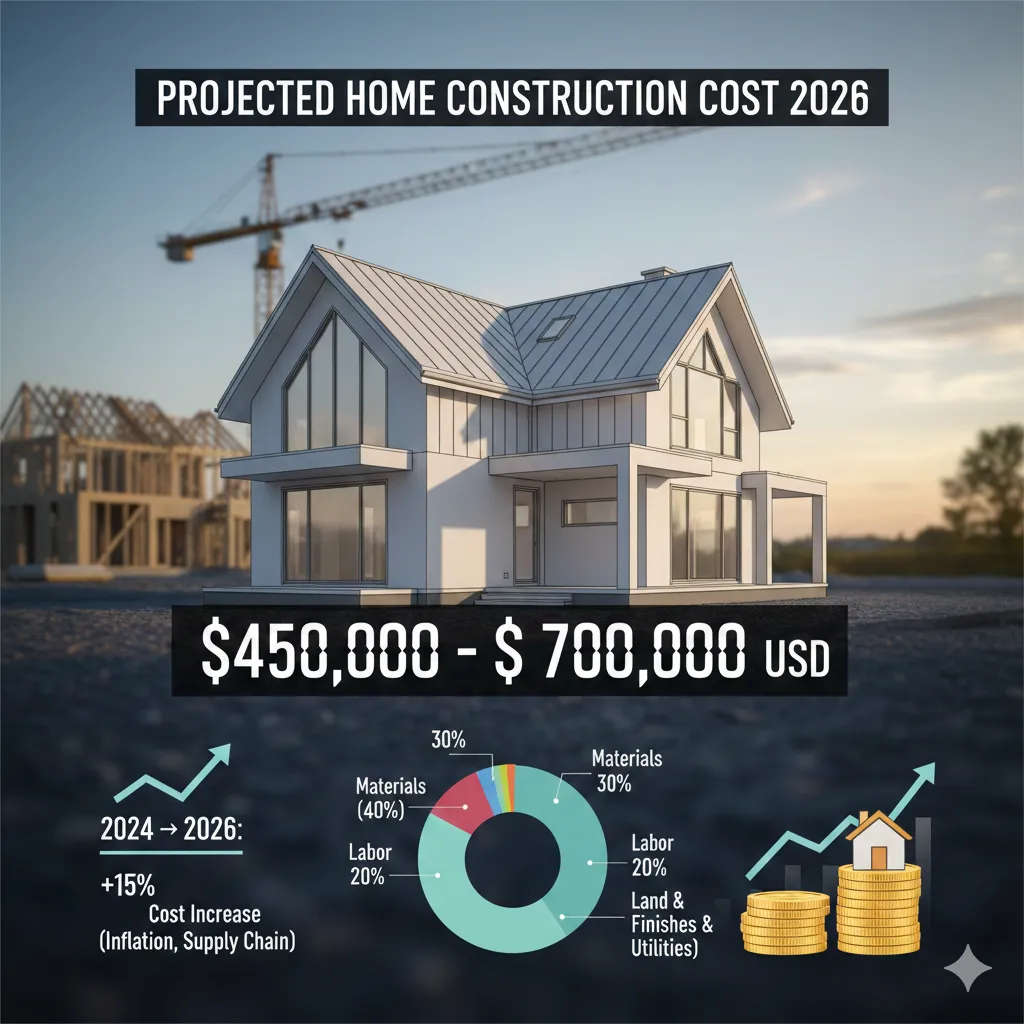
Cost to Build a House in 2026
Last week we poured the foundation for a 2,500 sq ft house on a sloped lot in Austin. The concrete alone came in at $16 per square foot - down from $18 in 2025. But our aluminum windows? They jumped 40% because of tariffs.
Here's what's actually happening with building costs in 2026, based on real numbers from our projects and conversations with 300+ builders across the U.S.

The Four Parts of Your Build Budget
Every house build breaks down into four major costs:
1. Land purchase - Your lot and site prep
2. Local materials - What you buy at Home Depot, local suppliers, concrete plants
3. Imported materials - Windows, doors, specialty items from overseas
4. Labor - Every crew you hire from foundation to finish
What changed from 2025 to 2026? Two moved down. Two moved up. Let's break it down with actual costs.

Land Costs: Good Lots Selling Fast, Difficult Lots Sitting
What We're Seeing:
Interest rates are still around 6%, which has a lot of sellers waiting. When we started building in Apache Shores, there were 10-15 buildable lots per year on the market. Now there are 40-45 lots available - but most are difficult to build on.
The Pattern:
Good lots sell in 2-3 days. Difficult lots sit for 300+ days. If it's been on the market that long, there's usually a reason - foundation challenges, steep slopes, utility issues, setback problems.
Pricing:
Generally 10-15% lower than 2025. Some markets dropped 50%. But supply of quality lots is actually tighter because sellers are holding good properties waiting for better conditions.
Our Take:
This isn't necessarily a buyer's market for land. Yes, there are more listings, but the buildable-with-reasonable-costs lots are still moving fast. You need to know how to spot the difference.
Materials you buy locally - concrete, lumber, trusses, most building supplies - stayed remarkably steady from 2025 to 2026.
Real Example: Our Concrete Costs
2025: $18/sq ft for slab (materials + labor + forms + rebar + plastic)
2026: $16/sq ft for the same work
Why the drop? We gave them a bigger project (5,000 sq ft vs 3,000 sq ft), and competition is higher. Concrete plants are hungry for work, so we can negotiate better.
The Pattern Across Materials:
What Changed:
Not the prices - but the competition level. In 2025, we'd get 2-3 bids and contractors were booked months out. Now we're getting 4-5 competitive bids, and crews are calling us asking for work.
This means better pricing and faster schedules, even though the material costs themselves haven't dropped much.
Imported Materials: This Is Where It Hurts
Here's where 2026 gets expensive - anything coming from overseas hit new tariffs.
Our Real Cost Increases (Austin Projects)
Why Such Big Jumps?
Direct tariffs: 25% on goods from China, 10% from Europe, varies by country
Indirect costs: Even U.S. manufacturers buy components abroad - they're passing tariff costs through
Demand pressure: When local manufacturers can't keep up with demand (which will happen), prices rise further.
What About Appliances?
Washer/Dryer Set:
2025: $800-900
2026: $1,200 (+33%)
Full Kitchen Appliance Package:
We're seeing 20-30% increases across the board. Some of this is tariffs (components come from overseas), some is manufacturers taking advantage of the market.
Labor Costs: The Good News
This is where you're actually saving money in 2026. The construction slowdown means crews are competing for work.
Real Labor Cost Changes (Our Austin Builds)
Why Labor Dropped
Simple supply and demand. The building industry slowed down. Contractors who were booked 6 months out in 2022-2023 are now calling us asking for work.
What This Means for You:
Better prices
Faster schedules (no 3-month wait times)
More leverage in negotiations
Your build won't drag on because crews are juggling multiple jobs
The Bottom Line: What Does a 2,500 Sq Ft House Cost in 2026?
Here's the complete breakdown from our spreadsheet - a real 2-story house with 3 bed/3 bath, 2-car garage, and swimming pool in Austin:
Complete Cost Comparison: 2025 vs 2026
2,500 sq ft House - Austin, TX
If You Need a Full Table in Excel just Click on this Link: DOWNLOAD NOW
What This Actually Means
The Surprising Truth:
Even with tariffs hitting imported materials hard, the overall build cost went down by $31,766 (about 4%) because labor savings more than offset the tariff increases.
The Breakdown:
Labor savings: ~$40,000 across framing, stucco, drywall, MEP
Tariff increases: ~$15,000 on windows, doors, appliances
Net result: You come out ahead
But There's a Catch:
This works if you're building a standard home using mostly local materials and basic imported items. If you're building a luxury home with extensive imported finishes, specialty windows, European cabinetry, etc., the math flips - you'll pay significantly more in 2026.
Who Actually Saves Money in 2026?
You'll build cheaper in 2026 if:
Building standard 1,500-3,000 sq ft home
On flat or moderately sloped lot
Using local materials for 70%+ of the build
Standard windows and doors (not specialty European/Asian products)
Basic to mid-range finishes from Home Depot/Lowe's
You'll pay more in 2026 if:
Building luxury custom home (5,000+ sq ft)
Extensive imported materials (special windows, European doors, imported tile)
Building on steep slope requiring extensive foundation work
High-end appliances and finishes from overseas suppliers

Why Now Is Actually a Good Time to Build
Beyond just the costs, there are three huge advantages to building in 2026:
1. No More Waiting in Line
In 2022-2023, we waited 4-6 months for framers to start. Now contractors are calling us. Your project moves faster, which means:
Less interest on construction loan (huge savings)
Less time in temporary housing
Faster to rental income or moving in
2. Better Quality Control
When crews are slammed, quality suffers. They rush. Now crews have time to do it right, and they want your good review for their next job.
3. More Negotiating Power
You're not competing with 10 other builds for the same crew. You can negotiate better terms, get the crew you actually want, and have leverage if issues come up.
How to Take Advantage
Here's your action plan:
Get Multiple Bids
Contractors are hungry. Get 4-5 quotes on every major trade. We're seeing 15-20% variance on the same scope.
Lock in Your Crew Early
Once you find good contractors at good prices, book them with a deposit. Market won't stay this way forever.
Focus Your Import Budget
Can't avoid imported windows? Fine - but choose domestic for everything else you can. Each imported item is 25-40% more expensive.
Move Fast on Good Land
Yes, there are lots on the market. But the buildable ones still sell in days. Have your financing ready and know how to evaluate a lot quickly.
Download the Full Spreadsheet
We've made our complete cost breakdown available. It includes:
Line-by-line costs for every item
2025 vs 2026 comparison
Cost per square foot breakdowns
Notes on what drove each change
Get it here: DOWNLOAD NOW
Building in 2026 comes down to one question: Are you building standard or luxury?
Standard home with local materials? You'll save money and build faster than in 2025. Luxury home with imported finishes? Budget 15-20% more for materials, but your labor will still be cheaper and your timeline better.
Either way, the contractor shortage is over. No more 6-month waits. No more paying premium prices because they're the only crew available. That's worth more than you might think.
Questions about your specific project? Drop them in the comments - I respond to every one.
Want the full system for managing your build? Our complete Building Your Home course covers every phase from land selection through final walkthrough. Learn more: DOWNLOAD NOW


