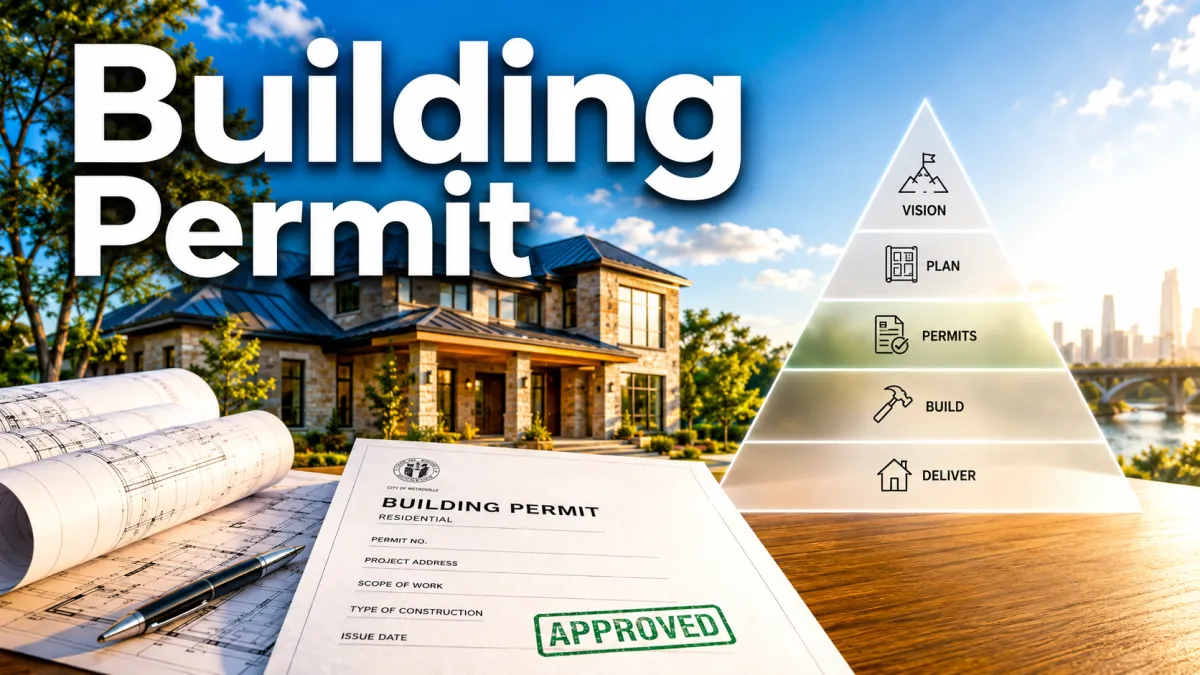
First-Time Builder's Guide to Building Permits. How I got it many times
Most people think a building permit costs a couple hundred bucks.
On a new home, the average is over $7,000. And the fee is the easiest part.
I've watched permits drag from two months to a year and a half. I've watched a protected bird freeze an entire build site for six months. I've watched one internet cable cost a builder $40,000 to move.
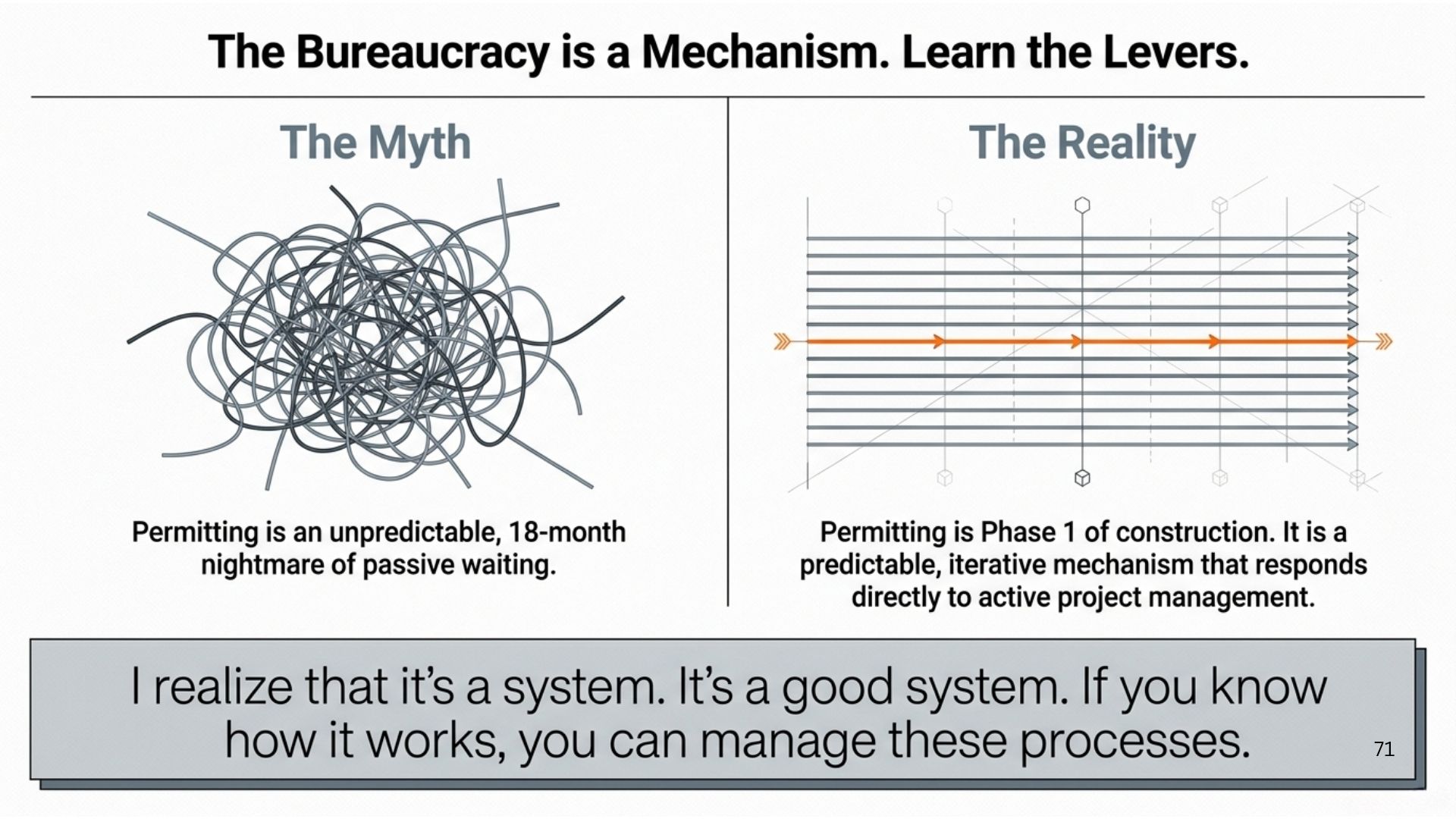
None of those people were unlucky. They all made the same mistake. They treated permitting as paperwork you wait on, instead of a process you manage.
So let me walk you through exactly how it works, so it never costs you what it cost them.
The whole thing has two halves, and beginners rush the wrong one
Here's the part nobody explains up front.
The permit process splits into two halves. Everything you do before you apply, and everything that happens after.
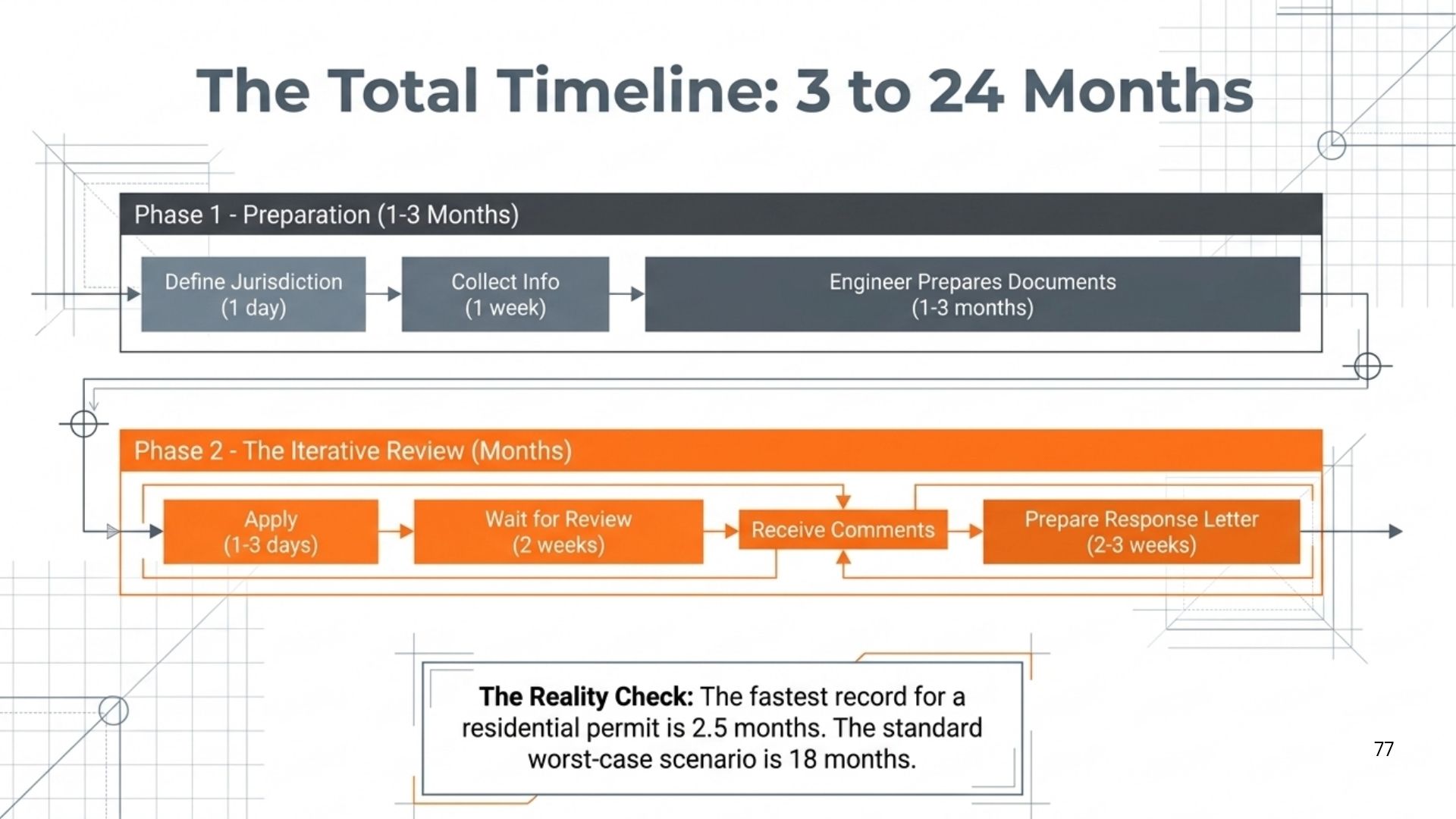
The first half is preparation, and it's all in your control. The second half is the review - a back and forth with the city. Most beginners sprint through the first half and then feel powerless in the second.
We're going to do the opposite. Six steps.
Step 1: Your empty lot might not legally exist yet
This one happens before anything else, and almost nobody sees it coming.
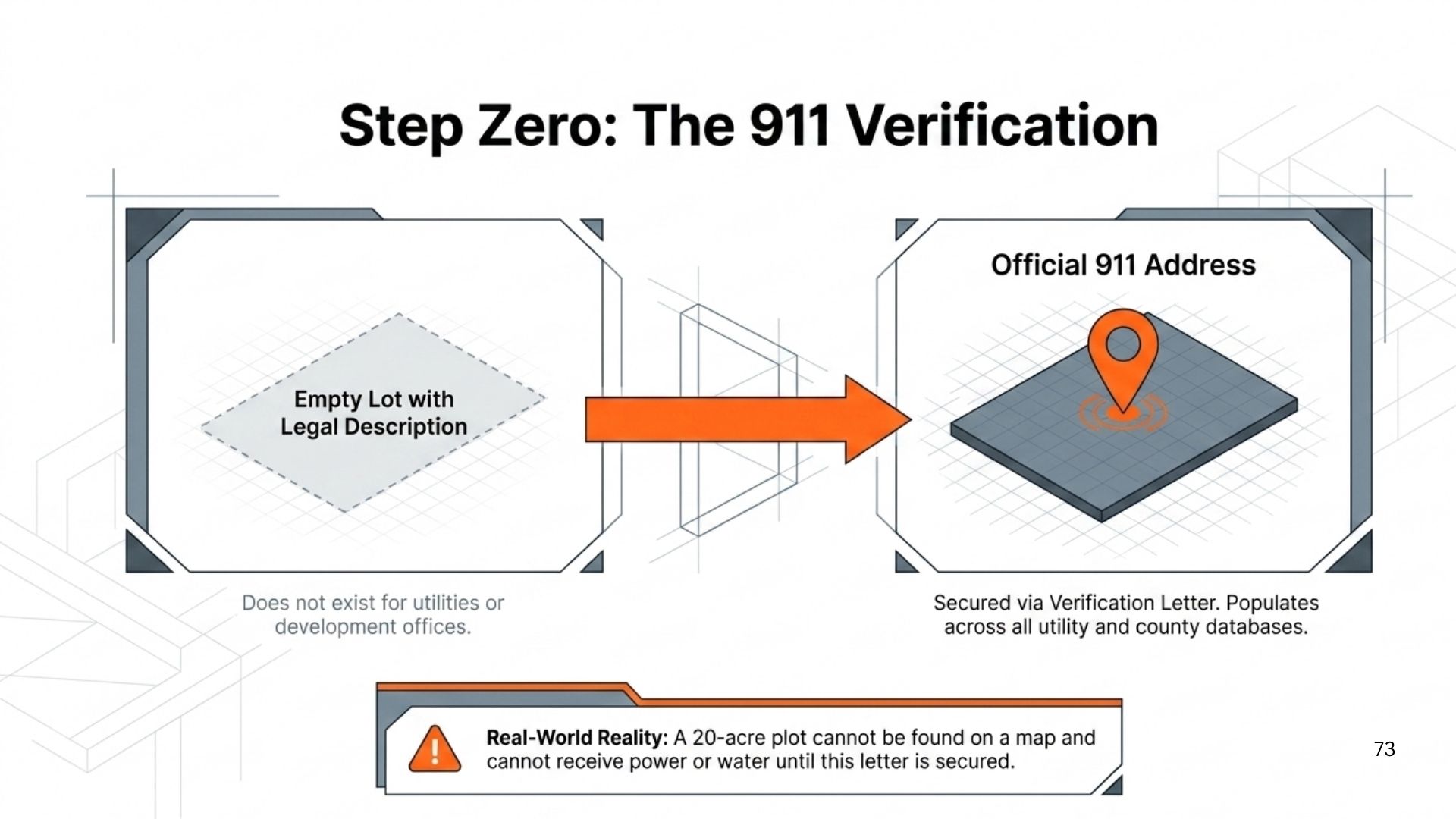
If you bought raw land, you might have a legal description - a string of numbers - but no street address. And that's a real problem. The utility company can't give you power or water without an address. The city can't process your application without one.
Your lot is a house with no name on the mailbox. The system literally can't find it.
So step one is to go to your local 911 addressing office and ask for an address and a verification letter. I watched a build on 20 acres where you couldn't even find the property on a map. The day that letter came through, the address populated across every county and utility database at once.
Get this first. Nothing else moves until you do.
Step 2: You don't answer to one office. You answer to a stack.
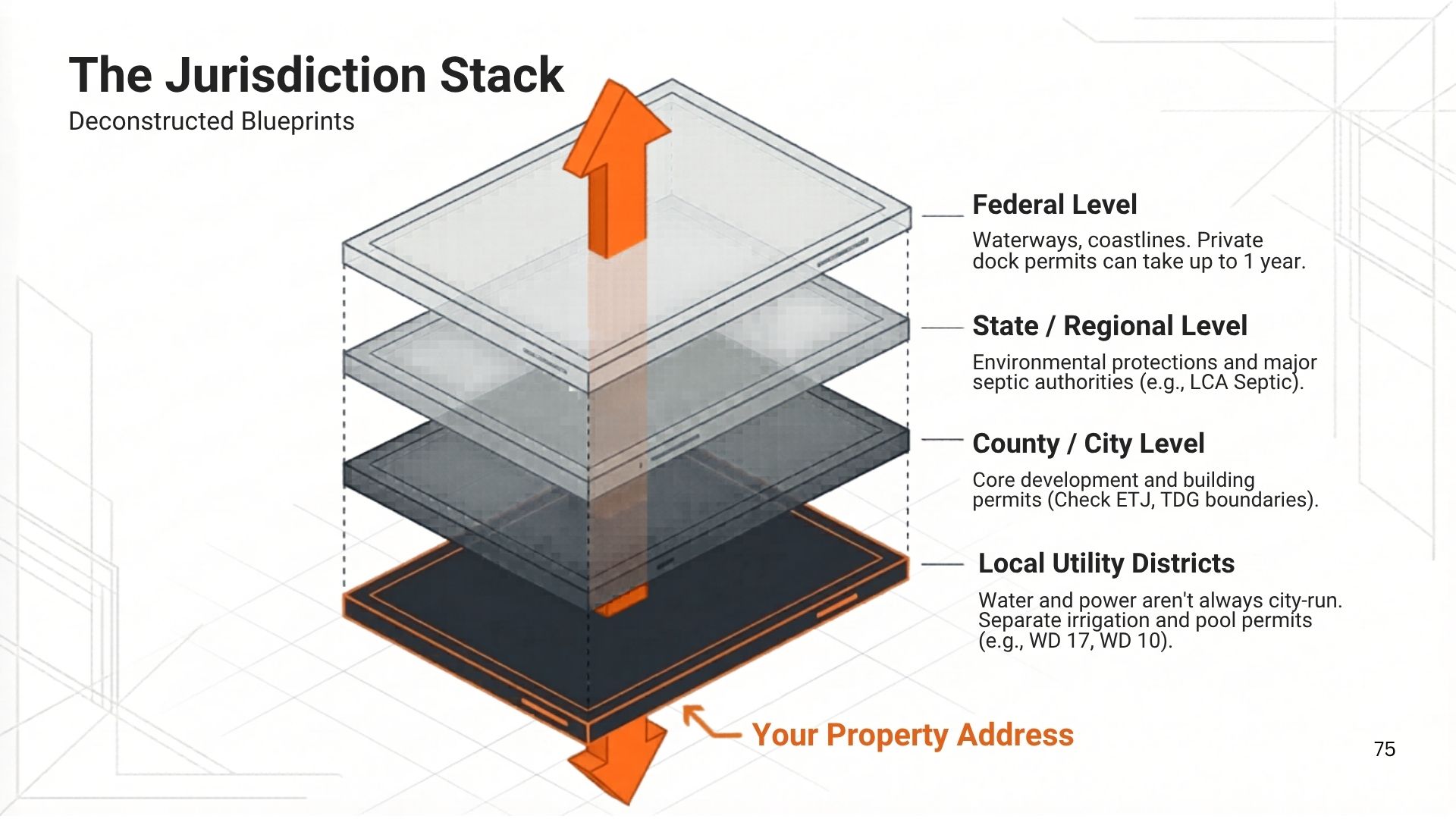
Permitting isn't one department. It's a stack of them, like floors in a building, and your lot sits at the bottom.
Depending on where you are, you might answer to the city, the county, a separate water district, and in some cases the federal government - all at the same time. A dock on the lake? That's federal. Your waterline might run through a utility district, not the city.
So the first question is always: who has jurisdiction over this lot?
Remember that $40,000 internet cable? This is the step that catches it. That cable belonged to AT&T, not the city. Completely outside city hall. Moving utility infrastructure means battling telecom companies, negotiating new pole installs, surviving department ping-pong, and eating months of delay. Utilities aren't always run by the city. They can be their own world.
Most big metros have a jurisdiction map online. Type in your address and it tells you which rules apply. Do this before you buy the land if you can, because your jurisdiction decides everything that comes next.
Step 3: There are more permits than you think, and one of them is a bird
Now you find out which permits your specific project actually needs. There are more than you'd guess.
There's the big one - the development permit. Think of it as the master key. It's what unlocks your right to start construction at all. (A handful of rural Texas counties are so hands-off they don't require one, and you can build with almost no permits. But any city in a developing area absolutely will.) Then a building permit, a septic permit, and often separate permits for plumbing, electrical, HVAC, a driveway, a retaining wall, a pool, even landscaping.
I personally wouldn't do landscaping on my own house and I still paid $4,000 just for an irrigation permit.
By the way, if you want to hear a real conversation with someone who does this for a living, check this episode with permit expediter Michael Kane is worth your time. He pulls 50-70 permits a month and explains exactly where the delays come from.
And remember that bird that froze a site for six months? That's this step too. In the Austin area, if your lot sits in a protected habitat for a species like the Golden-cheeked warbler, you can need an environmental permit just to clear your own land. One builder I know paid $12,000 for it, with only a six-month window to break ground. Miss the window and your site pauses for half a year.
So ask about environmental rules early. It gets very tricky and very expensive, very fast.
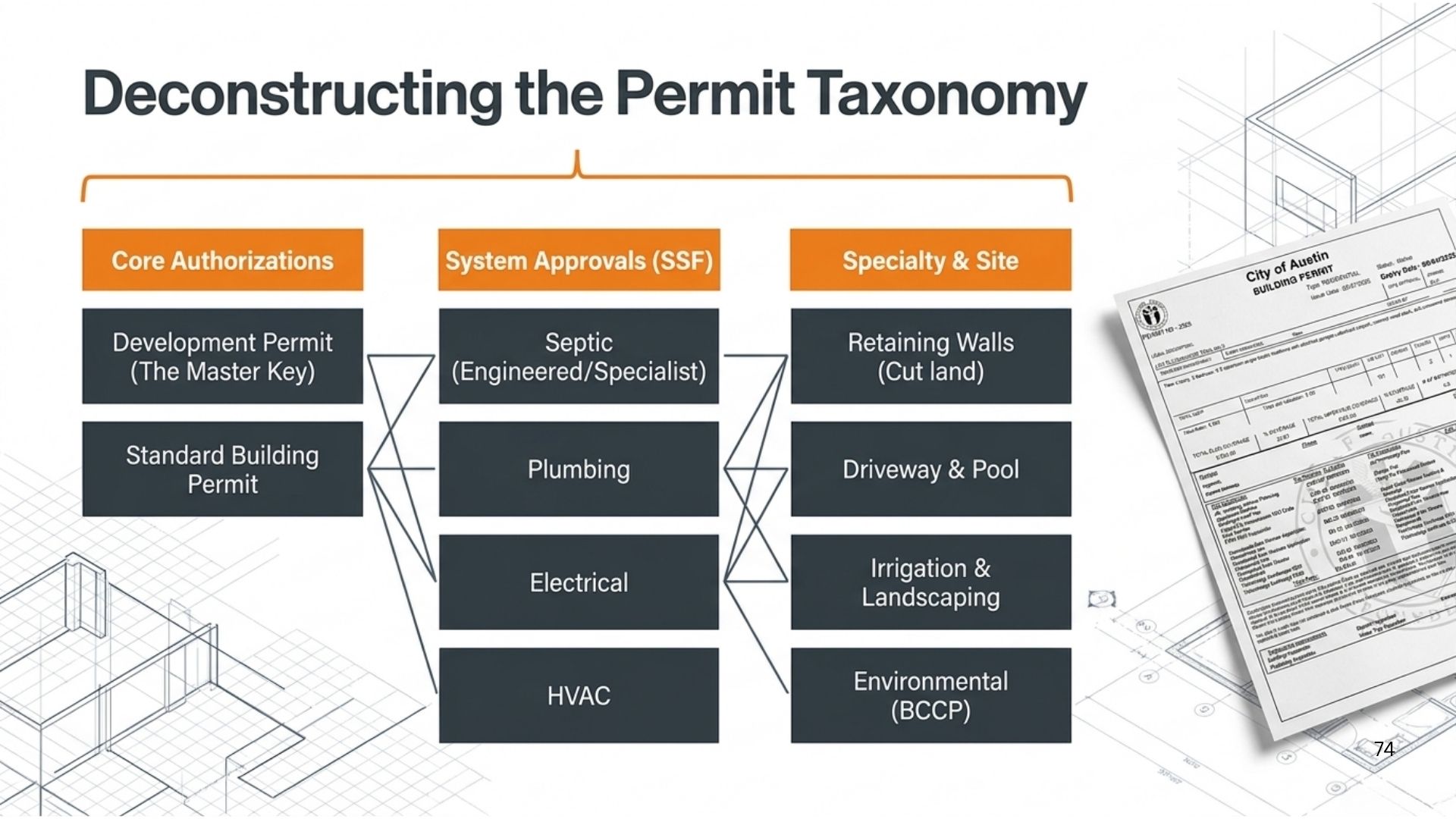
Here's the move, because you can't memorize all of this. Send one email to your jurisdiction: "What permits do I need to start construction on this property?" But they'll only tell you about their permits. They won't mention your water district or your power company. So you ask those separately. One email each. Make your list and you're ready.
Step 4: The prep that quietly eats your calendar
Step four is where the real time goes. Preparing your documents.
You don't draw these yourself. Your engineer, architect, and septic designer prepare the plans the city reviews. And here's the honest part: this usually takes one to three months. It's the longest piece of the prep half.
So start it early and stay on your design team. And remember - everything else the city asks for, it's on you to collect. Nobody chases it for you.
Step 5: Nobody gets a permit on the first try
This is the single most important thing to understand, and it surprises every first-time builder.
Getting a permit is not a test you pass or fail. It's a conversation. You submit your documents, they send back a list of comments, you fix them and respond, they review again. For a normal house, expect three to four of these rounds. Every round takes about three to four weeks. (Complex commercial projects can hit nine cycles.)
So how do you get through it faster? Be surgical.
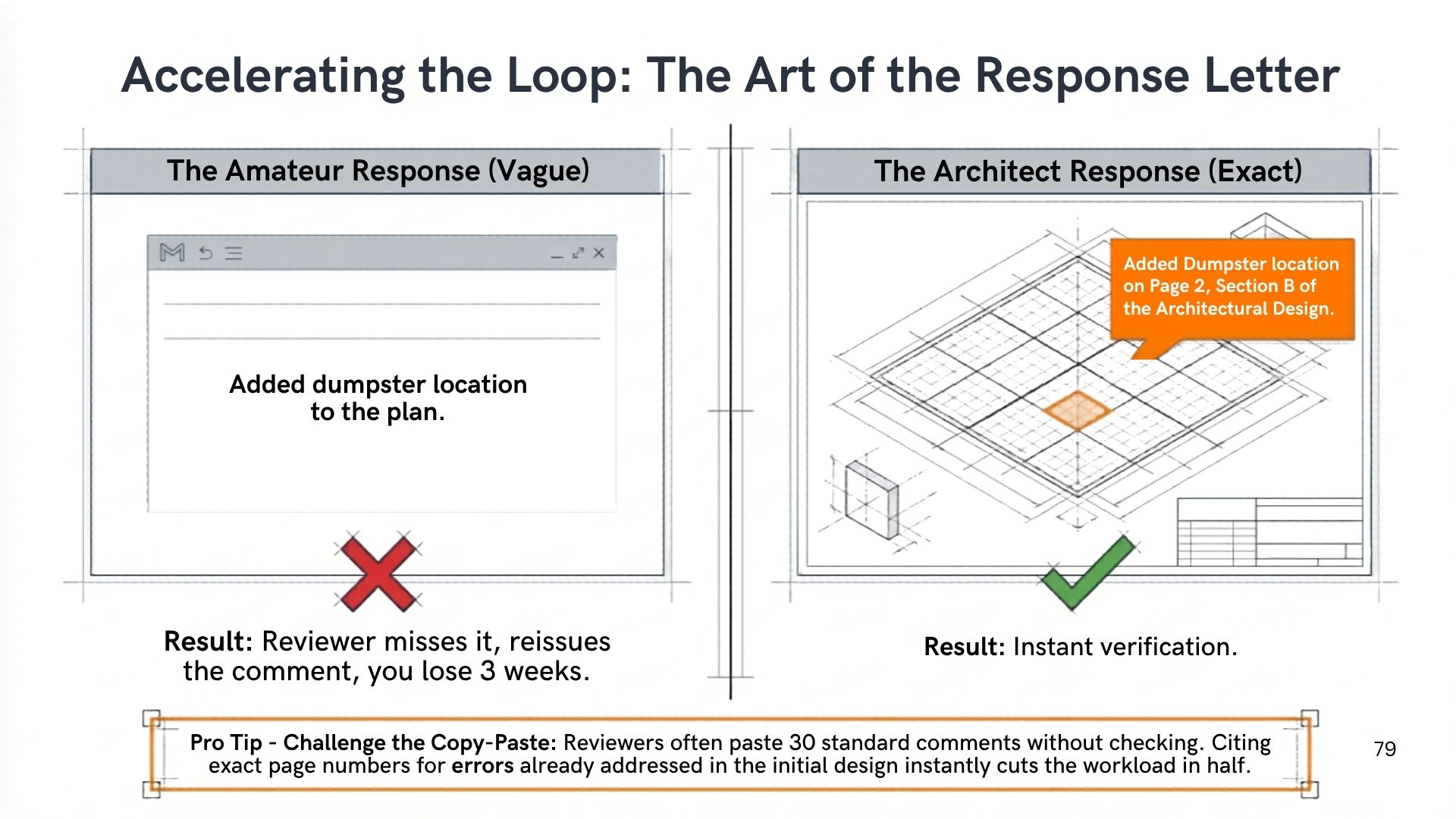
When they send comments, your response has to be exact. Don't write "I fixed the plumbing." Write "added on page three, section C." Cite the exact page every time. If a reviewer can't instantly see what you changed, they bounce the comment back and you just lost another month.
There's a hidden lever here too. Reviewers often paste 30 standard comments without checking your plans closely. When you cite exact page numbers for things you already addressed in the original design, you cut their workload in half and your file moves. Precise responses are the biggest speed-up in the entire process.
Step 6: Getting the permit isn't the finish line
You clear the last comment, they issue your permit, usually within a day or a week. Now you can legally build. But you are not done managing.
Two things will quietly bite you.
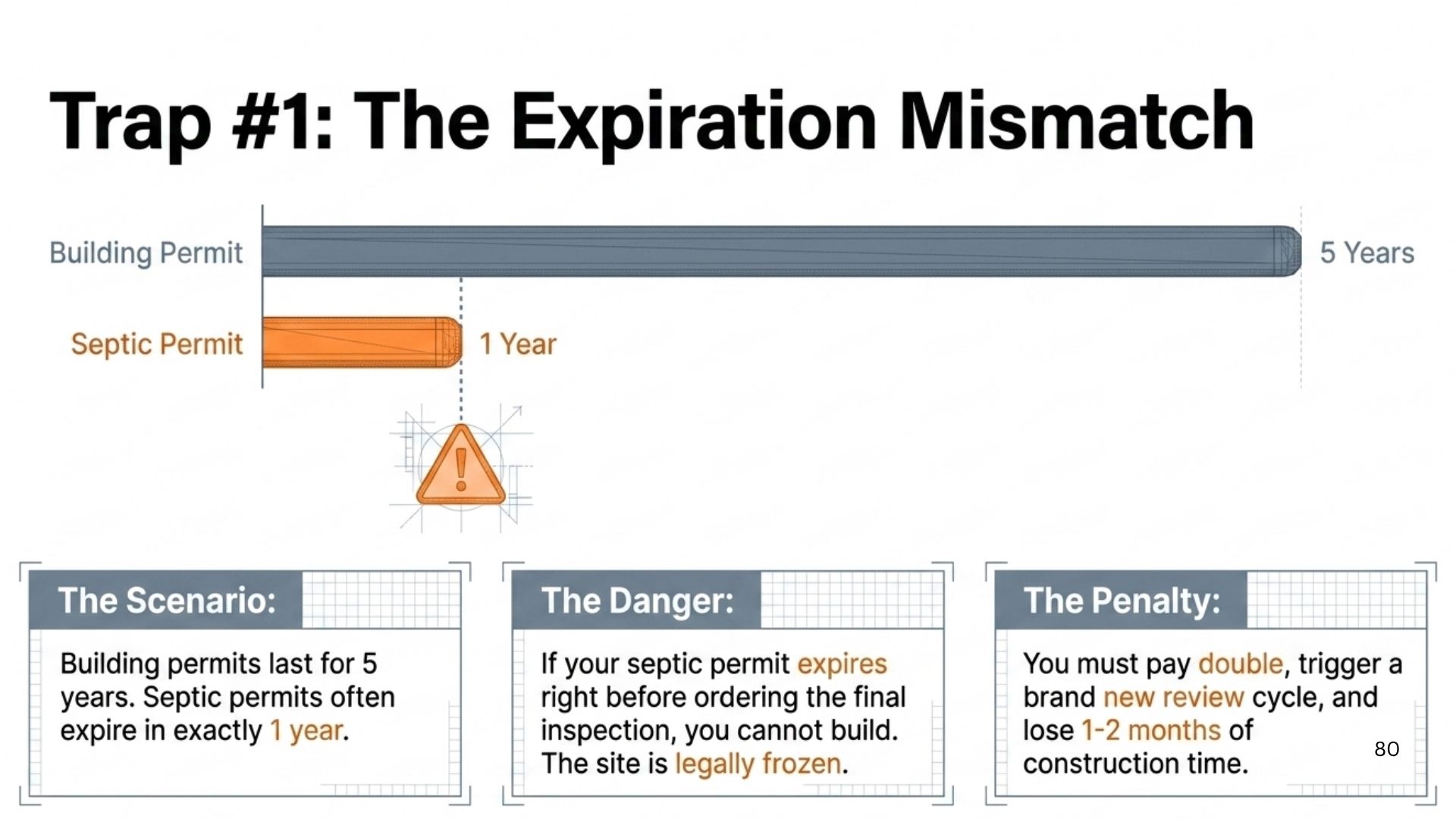
First, permits expire, and they don't all expire at the same time. A building permit might last five years. A septic permit might last only one. If your septic permit lapses right before the final inspection, you can't build. The site is legally frozen, you pay double, you trigger a fresh review cycle, and you lose one to two months.

And here's the nuance that saves you: if you file the renewal before the permit expires, it's a quick, easy renewal. File after it's expired and it's a whole new process from scratch - new fees, new review, new inspection. I've watched a builder lose two months on a finished septic field for exactly this reason. The field was in the ground, ready for final inspection, and the expired permit sent the whole thing back to square one. So write down every expiration date, and set your own reminder a step ahead of the real one.
Second, the city can add a fee to your account and freeze everything without ever emailing you. A $900 balance shows up in the portal, your project status flips to "paused for payment," and your inbox stays empty. I've watched this play out many times. Check your portal yourself once a week, like your bank account. The permit isn't truly yours until the project is done.
The real difference between builders who get permits fast and builders who don't
It's not connections. It's posture.
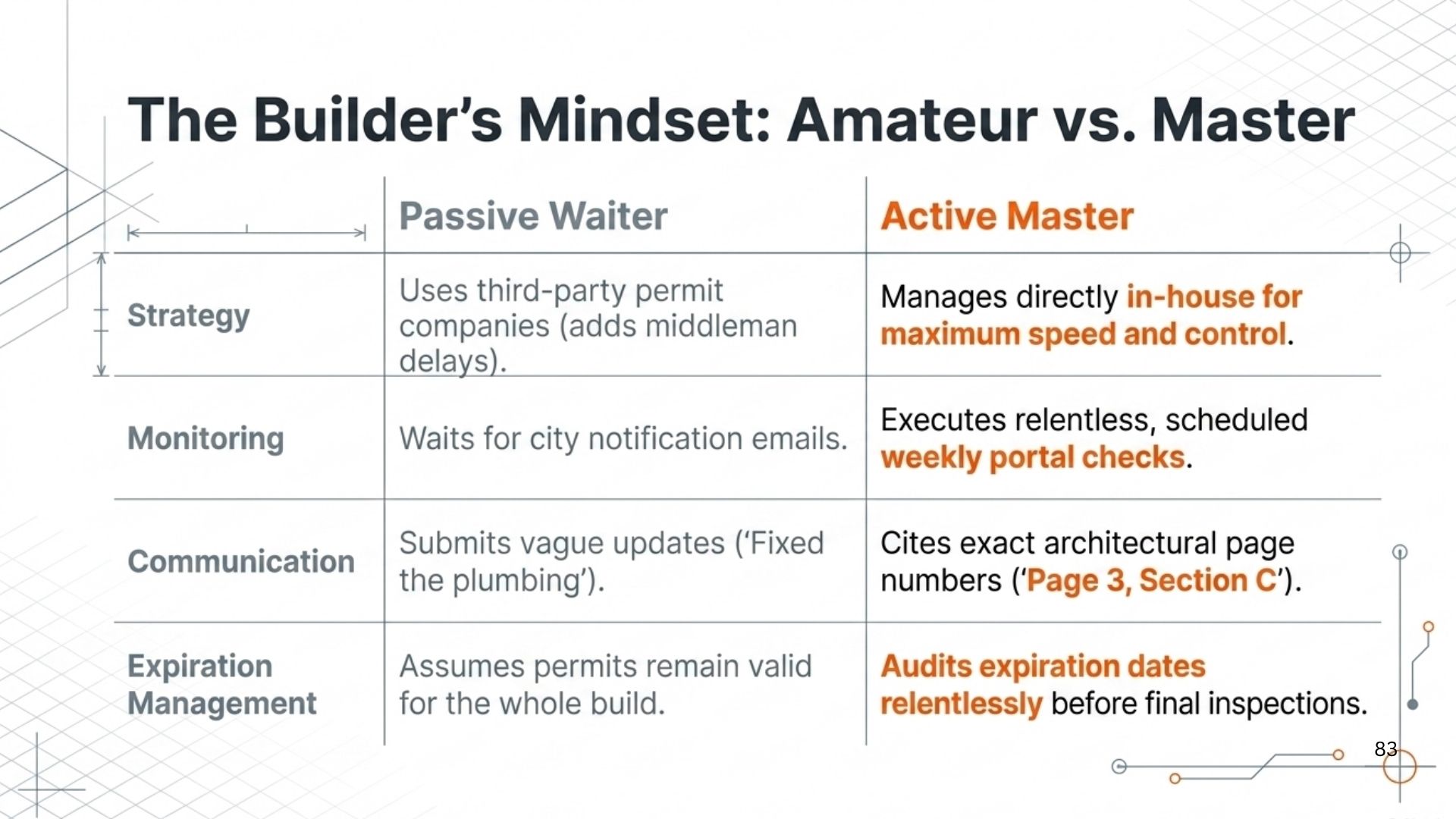
The passive builder uses third-party permit companies that add a middleman delay, waits for city notification emails that may never come, submits vague updates, and assumes permits stay valid for the whole build.
The builder who moves manages permits in-house for speed and control, runs scheduled weekly portal checks, cites exact page numbers in every response, and audits expiration dates before final inspection.
Same city. Same rules. Wildly different timelines.
One more thing nobody warns you about: the portals don't talk to each other
There is no universal permitting system. Neighboring jurisdictions run completely different platforms that don't share data.
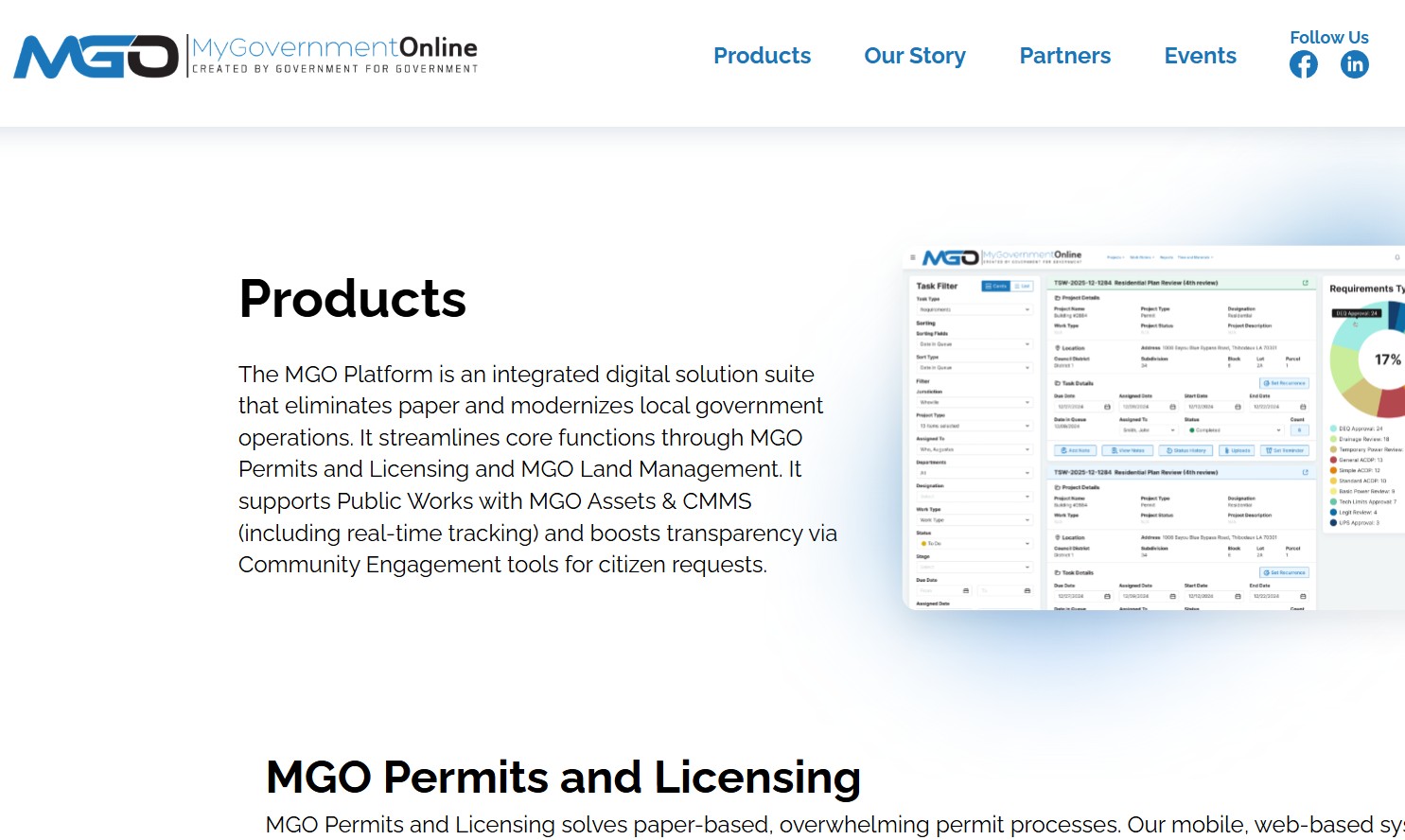
In central Texas alone you'll see MyGovernmentOnline used by Travis and Hays County, a totally isolated Austin ABC Portal that doesn't communicate with other systems, and wealthy enclaves like Lakeway running their own private permitting software. Figure out which stack your lot lives in before you're standing at the counter.
The whole playbook on one page
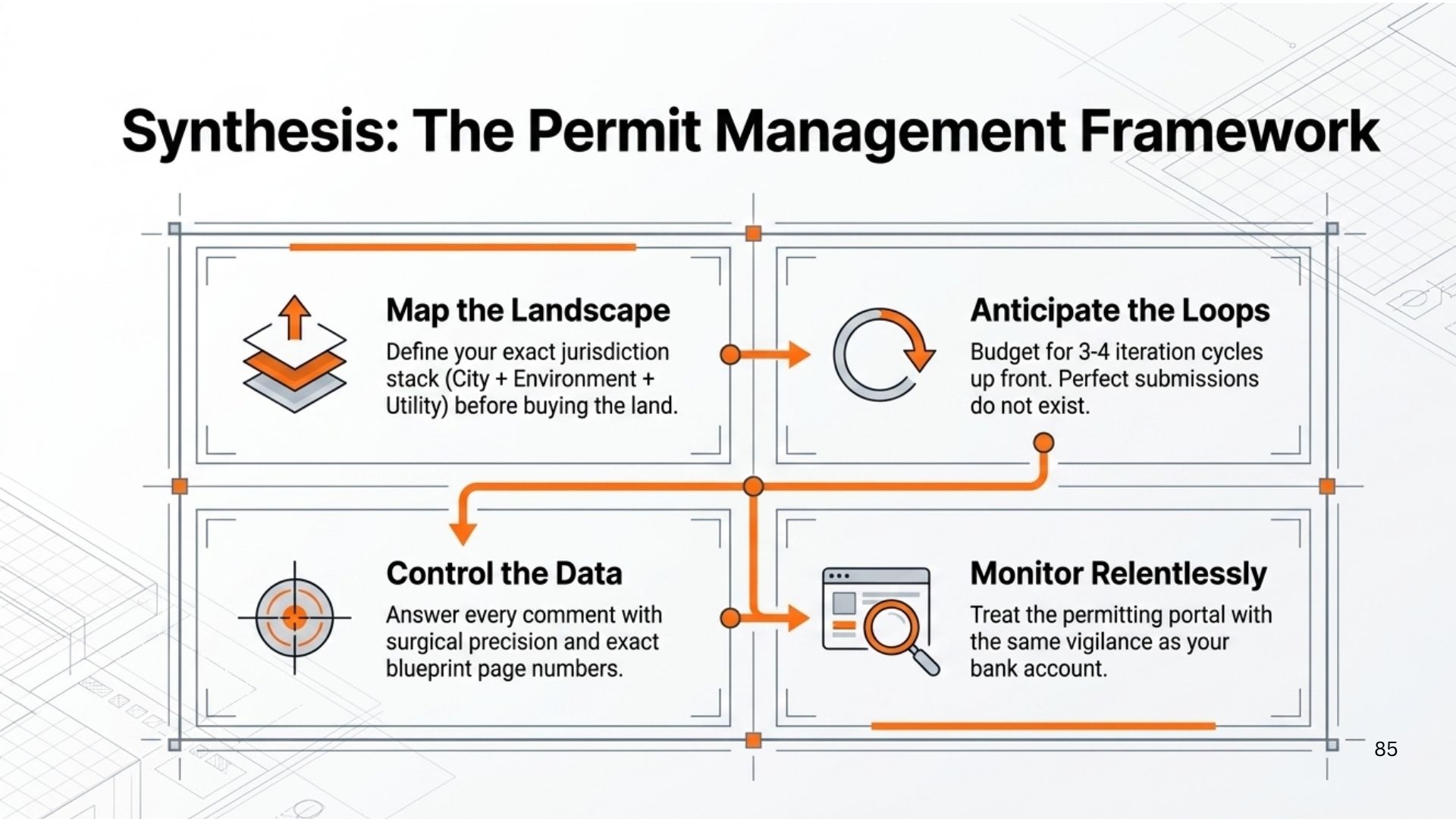
If you remember nothing else, remember these four moves.
Map the landscape. Define your exact jurisdiction stack (city plus environment plus utility) before you buy the land.
Anticipate the loops. Budget for three to four iteration cycles up front. Perfect submissions don't exist.
Control the data. Answer every comment with surgical precision and exact blueprint page numbers.
Monitor relentlessly. Treat the permitting portal with the same vigilance as your bank account.
Never forget they work for you
One more thing, because it changes how you show up.
The permitting department is a service company. You pay them fees. They are required to serve you. Most builders forget that and wait around like they're asking for a favor.
I worked with a builder who hit a wall and got told the line everyone gets told: just wait. He'd put real money into the project and he was not willing to sit for 18 months on someone else's clock. So he told them, plainly, that he was ready to take the story public and put it in front of a newspaper. He had his permit shortly after.
I'm not telling you to pick a fight on day one. The posture is the point. You're a paying customer with a project on the line, not someone begging at a window. Builders who carry themselves that way get answers. Builders who wait quietly get forgotten.
So plan for it
You heard me say two months to a year and a half. Where you land depends entirely on how well you prepare and how hard you manage the review.
Permitting isn't a week, and it isn't paperwork. It's a phase of your build, and it deserves the same attention as the construction itself.
From the first day to the last, you are the project manager. The city won't chase you. Your design team won't chase you. Nobody cares about your project the way you do. The builders who get permits fast aren't the ones with connections. They're the ones who stay on top of it every single week.
Your turn: what's the permit surprise that cost you the most time or money on your first build? Drop it in the comments. The bird and the cable can't be th
Want the full system for managing your build? Our complete Building Your Home course covers every phase from land selection through final walkthrough
Dmytro Bondar has spent 20+ years building educational companies, the last ten working with spec and custom home builders in Austin, Texas - on their projects, marketing, and production. He runs HouseBuilderPro, a YouTube channel and training program that teaches first-time and spec builders how to build a house from A to Z without losing money, with step-by-step guidance, coaching calls, and live on-site building events in Austin.
Questions about your specific project? Drop them in the comments - I respond to every one.


